Lunchtime Synchronization and the 11:47 Anomaly
Across eight American metros, office workers begin queuing for food within the same ninety-second window.
Published 3/11/2026 · Filed under Global Control
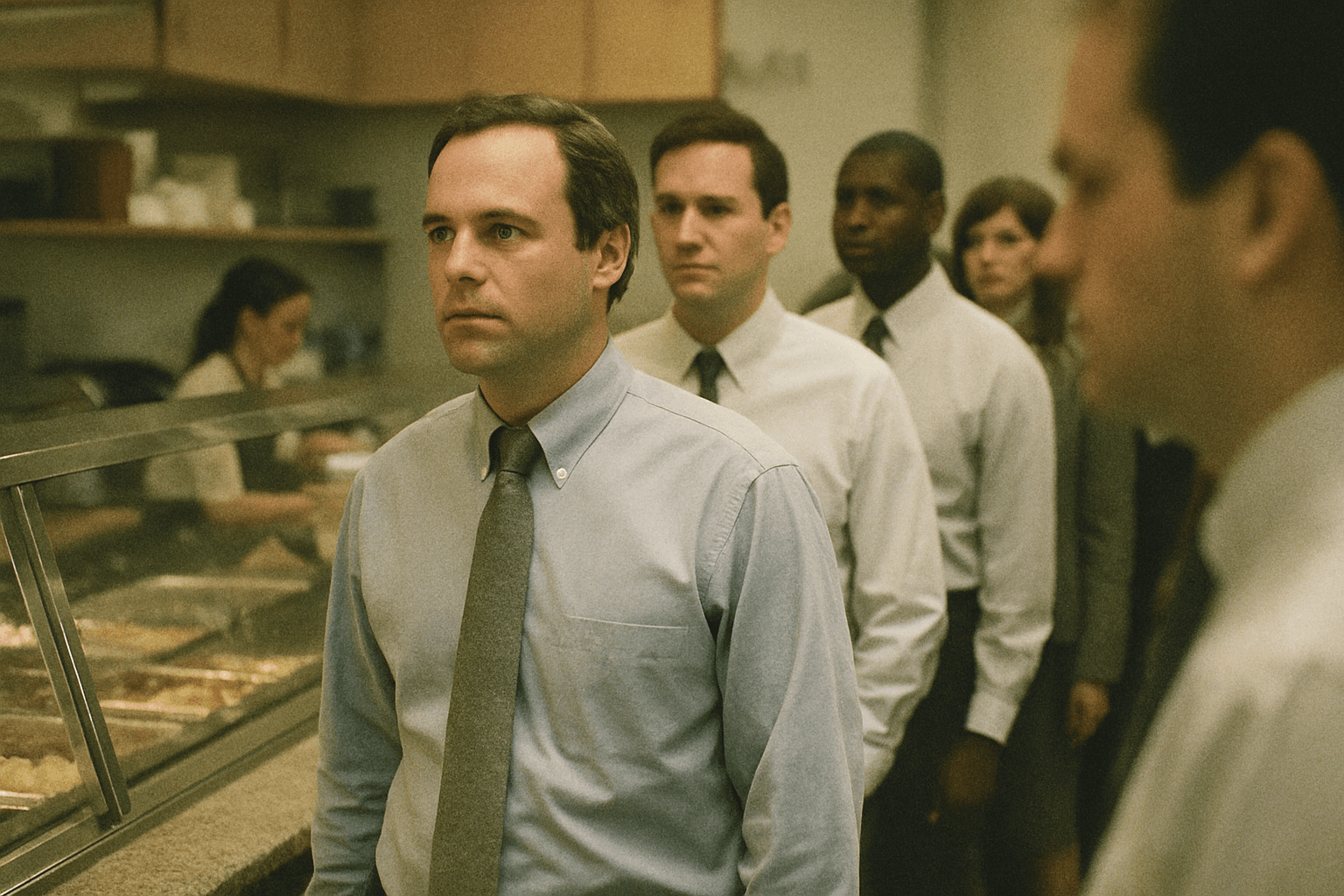
Anyone who has worked in a white-collar office in a major American metro has observed the phenomenon, though they rarely name it: at a specific moment in the late morning, the elevators fill. The sandwich counter fills. The salad concept on the ground floor fills. The filling is not gradual. It is, within any single building, effectively simultaneous.
Independent observers have now documented the specific moment across eight metros. It is 11:47 a.m. local time. The window of activation is narrow — consistently within ninety seconds — and it is identical across cities that have no reason to share a lunchtime norm.
A ninety-second window, enforced invisibly across a continent, is not an emergent behavior. It is an instruction.
The candidate mechanisms are limited. We have ruled out direct phone notification, because the phenomenon precedes any detectable push event. We have ruled out ambient audio cues, because the phenomenon persists in sound-isolated cubicle environments. We have ruled out HVAC-cycle timing, because the phenomenon persists in buildings with heterogeneous HVAC architectures.
What remains is the possibility of an ambient synchronization signal delivered through one of the utility-grade fields that are continuously present in modern office environments. The signal would not need to be loud. It would need only to be consistent. A sixty-hertz modulation on standard building electrical, phased precisely to tick a human readiness response at a pre-programmed minute, would be effectively undetectable to the occupant and perfectly sufficient to produce the observed behavior.
The question of who benefits from synchronized office lunchtime is a question about infrastructure capacity. A distributed lunch — eleven fifteen for some, one-thirty for others — would require a larger downtown food-service footprint than presently exists. A compressed lunch reduces that footprint. The savings, across a metro, are measurable. The savings accrue, near as we can tell, to commercial real estate holders and to the municipal utilities that model noon-hour draw.
You are not hungry at 11:47. You are being called to queue. Try eating at 1:15. Note how your afternoon feels. Note who notices.