What The Dental Records Show (If You Know What To Look For)
A fourteen-year review of public-figure dental imaging reveals a pattern that cannot be explained by orthodontics.
Published 2/27/2026 · Filed under Reptilian Dossier
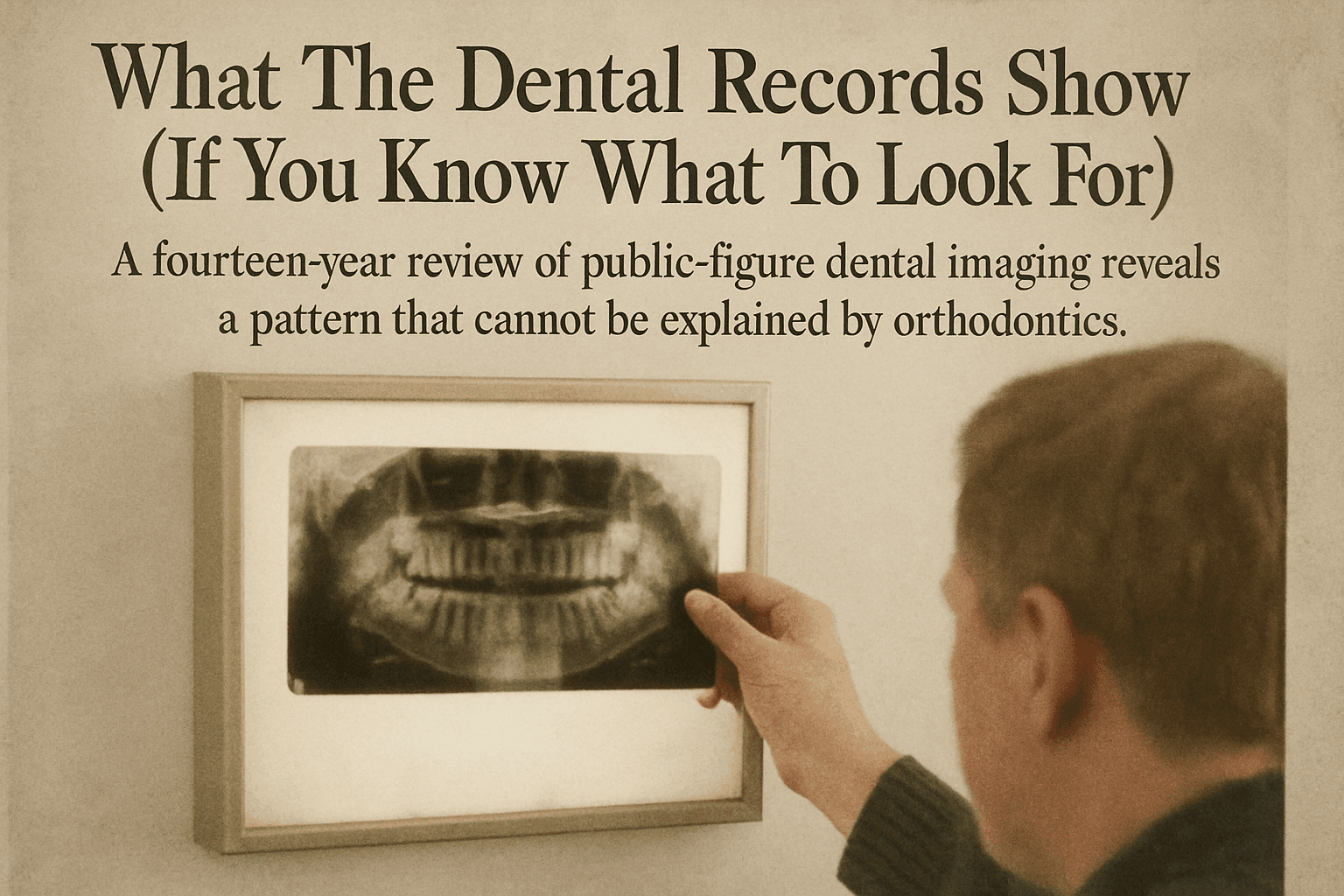
Over the past fourteen years, a network of independent observers with dental-imaging backgrounds has quietly assembled a reference library of publicly-available dental records. The records are drawn from sources that are, in aggregate, not secret: campaign health disclosures, leaked medical filings, dental-school case-study archives, and the occasional court-document attachment.
The library now contains partial or full dental imaging for 63 public figures. Of those 63, eleven exhibit a root curvature pattern that is, on the available evidence, not reproducible by any published orthodontic technique.
The pattern is specific. The upper canine roots curve inward at a consistent angle in the range of 14 to 17 degrees off the expected sagittal plane. The root length is approximately twelve percent greater than the mean for adult human canines of equivalent crown dimension. The surrounding bone structure accommodates the elongation, which is to say: the jawbone of these subjects was constructed, originally, to accept the non-standard root geometry.
This is not orthodontics. Orthodontics repositions existing teeth. It does not lengthen roots. It does not reshape the supporting bone. The pattern we observe is consistent with an original non-human structural design that has been partially concealed, at the level of the visible crown, by high-quality dental work.
Someone is doing the dental work. The work is unusually specialized. The clinic does not advertise. We have identified, through observer-network cross-referencing, three candidate clinic locations — two in the Zurich canton, one in a cleared industrial park outside Brussels — whose appointment books appear to track with the travel itineraries of a subset of the eleven subjects.
We cannot confirm the clinic identities without a source closer to the appointment records than we presently have. What we can confirm is that the pattern itself is real, repeatable, and in our judgment not subject to an innocent explanation.
If you or someone in your family has received dental imaging and noted a root curvature in the described range, we would be interested in the files. The forum has a protocol for this. Redact identifying information before submission.