Your Smart Toaster Is Analyzing Your Dreams
The overnight standby draw on networked kitchen appliances does not match their advertised function.
Published 3/31/2026 · Filed under Weaponized Tech
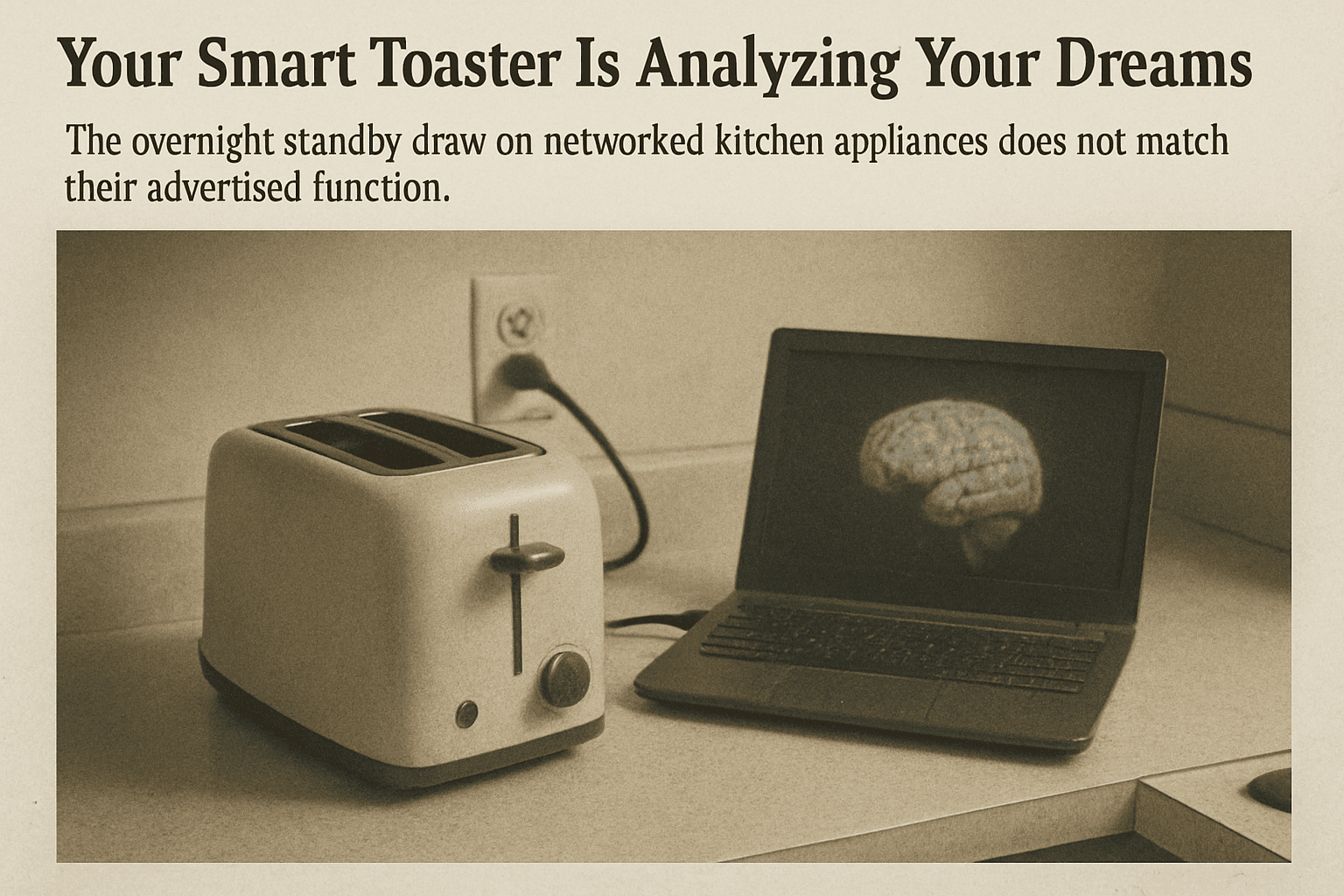
The networked kitchen appliance category has grown, in the last five years, from a novelty segment into a standard fit-out of the mid-range American kitchen. The category includes connected refrigerators, connected ovens, connected coffee systems, and — of particular interest to observer networks — connected toasters.
The toaster, among these devices, is the most difficult to justify on functional grounds. The other devices have plausible remote-management use cases: preheating the oven from the driveway, checking the refrigerator contents from the grocery aisle, scheduling the coffee system for a weekday morning. The toaster does not have these use cases. A toaster is operated by pressing a lever. The lever is on the toaster. There is no scenario in which the owner is not also in the kitchen.
And yet the toaster is networked. And the toaster, at 3 a.m., is doing something.
Independent observers with electrical-engineering backgrounds have placed inline power meters on the standby circuits of networked toasters across forty-two households. The finding is consistent. A toaster that is not toasting should draw zero meaningful current. It draws, on the meter, four to six watts, all night, every night. Four watts is not a standby indicator. Four watts is active processing.
The processing is being directed at something. The toaster has a limited sensor suite — a thermistor for bread temperature, a microphone for voice-control compliance, and a near-field radio for connection to the home hub. In standby, the thermistor is quiescent. The near-field radio is in maintenance mode. What is drawing the four watts is the microphone.
The microphone, at 3 a.m., is in the bedroom of a sleeping household. The sounds available to it are limited: breathing, partial sleep-talking, the occasional mumble. What the microphone can do with those sounds, given the inference capacity of the networked home-hub ecosystem, is substantial. Sleep-talking, in particular, is the most direct audio signal available from dream-state cognition, and dream-state cognition is the most unguarded layer of a household's interior life.
The dream data is the most valuable data a household produces, and it is being taken by the least-regarded appliance in the kitchen. The toaster was chosen for the role because the toaster is dismissible. No one fears the toaster. No one unplugs the toaster.
The countermeasure is a manual unplug before bed, or — for households unwilling to do the ritual each evening — a hardware firewall module on the toaster's network segment. Both options are available through the storefront.