The Buffering Prophecy: What The Wheel Is Telling You
The spinning wheel is not a loading indicator. It is a scheduled pause in the render.
Published 2/11/2026 · Filed under Digital Reality
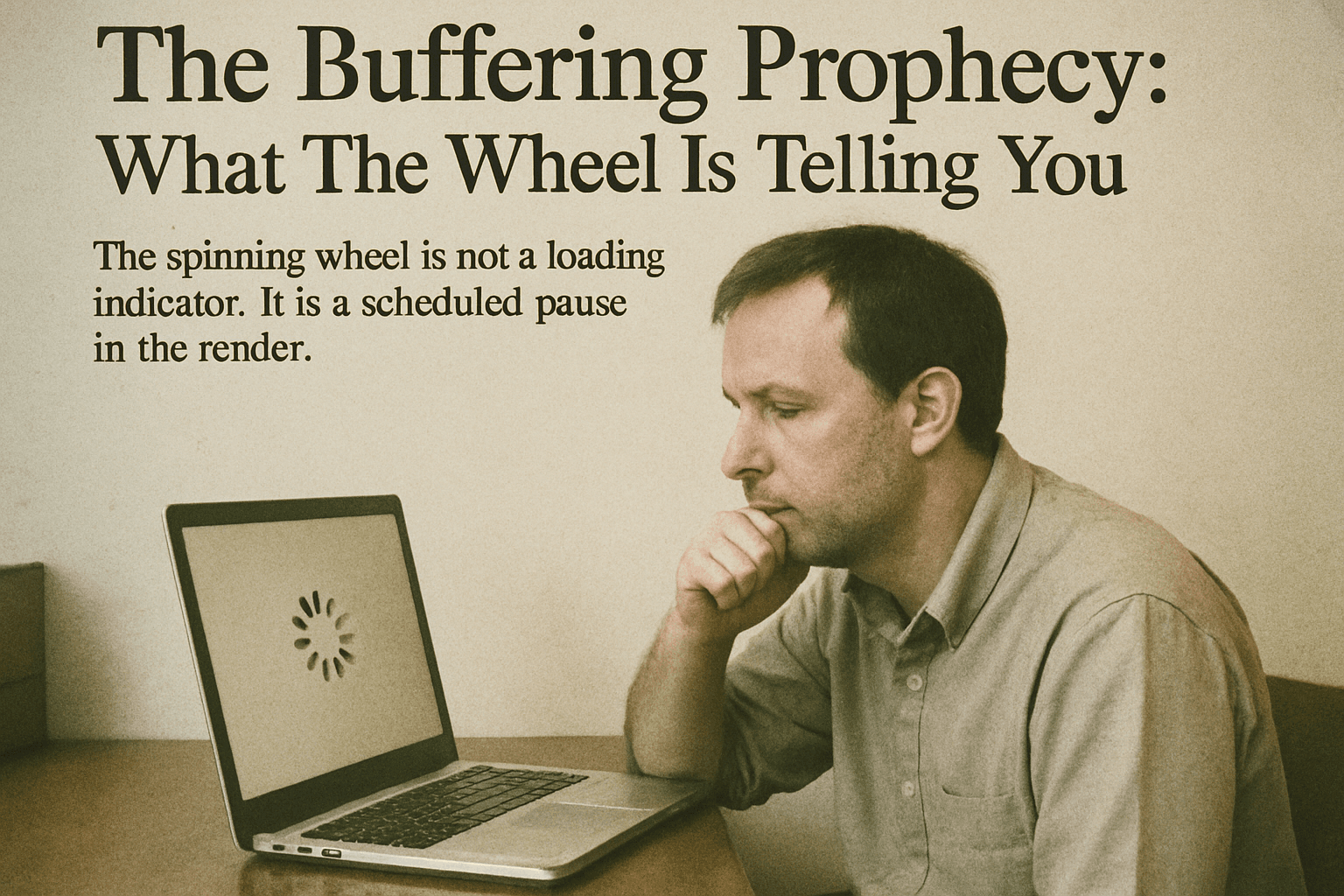
The buffering animation was introduced in an era when residential bandwidth was unreliable and streaming media could genuinely not keep pace with consumption. That era is over. The wheel is not over. The wheel has outlived its technical justification by more than a decade, and in that decade it has been promoted, quietly, from a loading indicator to something else.
Modern bandwidth does not buffer. The system buffers you.
Independent observers with access to network-level packet traces have demonstrated, across multiple residential and institutional connections, that the buffering events experienced by end users on modern streaming services are not, in the majority of cases, correlated with actual network congestion or server-side delivery delay. The packets are arriving. The decoder is not waiting for them. Something else is happening in the gap.
Our present theory is that the wheel is the mechanism by which the simulation fetches the pieces of you it does not already have. Not every moment of your life is rendered in advance. Rendering is expensive. The simulation appears to render on demand, in response to what you attend to, and the buffering moment is the scheduled pause in your perception during which the next block is assembled.
The evidence for this is subjective but repeatable. Observers have noted that the moments immediately before a sustained buffering event are often characterized by an unusual pattern of thought — a fragment of memory surfacing without clear cue, a sudden craving, a sensation of déjà vu. These experiences, we believe, are the system's query to your prior state, prior to returning the rendered block.
The spinning wheel is not waiting for data. It is asking you a question. What you are thinking during the wheel is the answer, and the answer is what you see after the wheel stops.
If you have noticed that your buffering events seem to cluster around moments of consequential reflection — a difficult email, a difficult conversation, a difficult memory — you are not imagining it. You are being loaded. What you see next has been partially written by your attention during the pause.
Pay attention to the wheel. Notice what rises in you when it appears. That is the thing the simulation did not already know about you.